

Hair transplant in Dubai
Agreed in the mirror, before a graft is taken.
A consultation comes first. The hairline is drawn on the scalp, and you see it before a graft is taken. Whether surgery is appropriate depends on your donor area, your health, and what can realistically be covered.
Request a consult
A coordinator replies on the number you leave. You decide about a sitting after you have heard the plan.
The procedure
Your own follicles, moved from where they still grow.
A hair transplant is a surgical procedure. Follicular units are taken from the donor fringe at the back and sides of the scalp and placed into areas of pattern hair loss. Dubai Health Authority describes it as a treatment option for male and female pattern hair loss when the donor area, general health, and expectations are suitable. It does not create new hair, and it does not stop future thinning of the hair left behind.
Learn about our methods- Licensed physiciansHair transplant is carried out by a doctor licensed to practise in Dubai, within this clinic’s facility licence and that doctor’s professional scope.
- FUE and DHIBoth move your own follicular units. The method is chosen after the donor area is examined.
- Hairline agreed in personDrawn on the scalp in ordinary light. You see it in a mirror before any graft is taken.
- Fee before bookingThe plan, the graft estimate, and the fee are explained at consultation. You can leave and decide later.

The process
Five steps.
Nothing booked in a hurry.
From the first visit to follow-up, the plan, the limits, and the fee are explained before you decide. You can stop after the consultation.
- 01
Consultation
Hair-loss pattern, donor area, general health, and what you hope to change are assessed. Photographs are taken. A transplant is not assumed.
- 02
Planning
If surgery is suitable, the hairline and a graft estimate are discussed. The safe number depends on donor density, head size, skin, age, and whether a later session may be needed.
- 03
Consent
The treating doctor explains benefits, limits, risks, cost, and whether more than one session may be required. Written consent is taken before the procedure.
- 04
Procedure
Usually one day, under local anaesthetic. You stay awake. FUE or DHI is used as agreed for your donor area.
- 05
Follow-up
You leave with written aftercare. Growth is reviewed over the following months. Medical treatment is often advised as well, because pattern hair loss can continue in hair that was not moved.
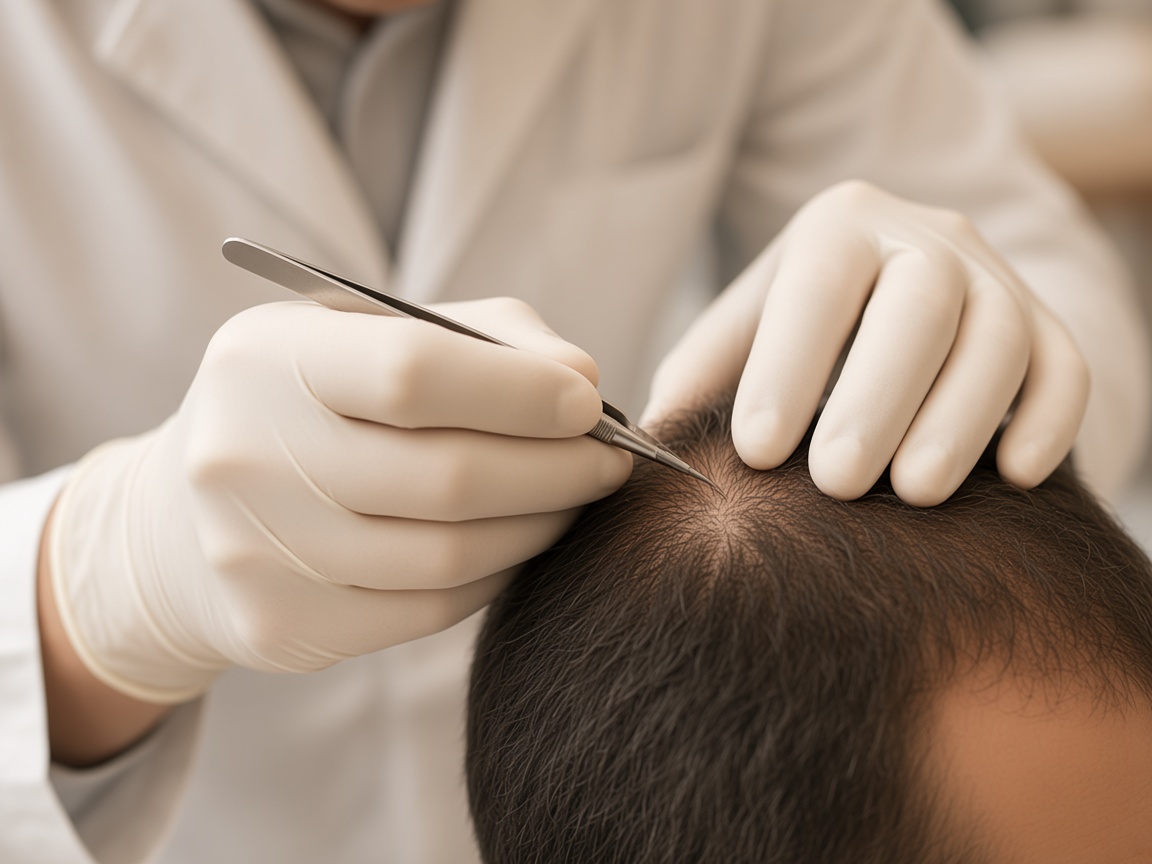
Our methods
Two ways to place the same donor hair.
FUE and DHI are offered at StyleAge. The difference is how the grafts are placed, not a promise of density. Strip surgery (FUT) is a recognised method in Dubai; it is not the method described on this page.
FUEFollicular Unit ExcisionFollicles taken one by one. No strip, so no single linear scar.
Small, naturally occurring follicular units are excised with a micro-punch from the donor fringe above the ears and around the back of the head, then placed into the area of hair loss. This is often how a larger area is covered. Tiny dot marks can remain in the donor area. How visible they are depends on hair length, healing, and how many grafts are taken.
DHIDirect Hair ImplantationThe same FUE harvest, placed with an implanter.
After the follicles are taken, each graft is placed with an implanter pen that sets angle, direction, and depth as it goes in. It is often used on the hairline, and where hair is added among hair that is still there. It uses the same donor hair as FUE. It does not create new follicles, and it is not offered as a higher-density guarantee. A session can take longer per graft.
Who is assessed
Pattern hair loss, a usable donor area, and a clear aim.
Dubai Health Authority standards say a person in good general health, with a good donor area and reasonable expectations, may be considered for transplantation in pattern hair loss. The examination decides. A photograph sent in advance can start the conversation. It is not a diagnosis.
A hairline that has moved
Temples, or the frontal line, planned against the donor hair available. A teenage hairline is not the aim in adult pattern loss.
Crown, or a widened part
Coverage through the top, including women with pattern hair loss and a usable donor area. Not every cause of women’s hair loss is treated with surgery.
An earlier transplant
A review of grafts already placed. The first conversation is what can be changed, what cannot, and whether the donor area can still supply hair.
The day
One sitting. You go home the same day.
Most sessions last several hours, depending on the number of grafts. Larger plans are sometimes split. Pre-operative blood tests are arranged before the day, including a blood count, clotting, and blood sugar, as required for the procedure.
- 01ArrivalPhotographs first. The plan starts from the donor area you actually have, not from a graft number quoted in advance.
- 02DesignThe hairline is drawn in ordinary light, with your age and facial proportions in view. You look in a mirror before anything is taken.
- 03ProcedureLocal anaesthetic is used. The injections sting, then the scalp is numb. You are awake. Breaks are taken during a long sitting.
- 04HomeYou leave the same day with written aftercare. Direct sun, swimming, and hard exercise wait until you are cleared.
Recovery
What the year after usually involves.
These are typical stages, not a schedule that every scalp follows. Shock shedding is expected. Early growth is uneven. Proper hair growth is generally looked for from about nine months, and the result is reviewed through the first year.
The day
You go home
The sitting is long, often several hours. You leave the same day with aftercare in writing, including how to sleep, wash, and what to avoid.
Days 1–10
The scalp settles
Redness, tenderness, and swelling are common. Swelling often peaks around days 2–4. Scabs loosen over the first week or two. Desk work is often possible before day 10 if the job is not physical.
Weeks 2–8
The shed
Transplanted hairs often fall. The follicles stay in the skin. This is expected. Hair next to the grafts can shed for a time as well.
Around month 4
Early growth
New hair tends to show. It often comes in fine at first. Timing varies, and some people see little change at this point.
About 9–12 months
The review
Dubai Health Authority guidance is that proper hair growth can be expected after about nine months. Direction, coverage, and the hairline are reviewed through the first year. A further session is sometimes discussed. Growth is not the same for every person.
Limits
What surgery can and cannot do.
A transplant redistributes hair you already have. Coverage depends on the donor supply. The consultation is also where a procedure is declined, if the donor area, the cause of hair loss, or the aim make surgery a poor plan.
The donor area is finite
Follicles are moved, not newly created. How many can be taken safely depends on the donor zone, hair density, head size, skin, the technique, your age, and the chance of a later session.
Pattern loss can continue
Hair around the transplant can keep thinning. Most people with pattern loss are advised to consider medical treatment as well as surgery. Surgery does not stop the underlying process.
More than one session may be needed
If further work is likely, that is said before you consent, and the cost of surgery and follow-up is set out in writing. A single sitting does not restore a full head of hair in advanced loss.
Risks are part of consent
Possible effects include swelling, redness, itching, temporary numbness, infection, bleeding, shock loss, uneven growth, visible donor marks, and a result that differs from what you hoped. Poor wound healing is uncommon and still discussed. “No risk” is not an accurate description.
Questions
Answers before you book.
What people ask before a first consultation. The answers describe the procedure in general. Your own plan is confirmed only after you are examined.
01Will people be able to tell?
The hairline is drawn so single hairs sit at the edge and the direction follows how your hair grows. Whether anyone notices depends on that design, on healing, and on your hair. It cannot be promised that a transplant will be undetectable.
02Does the sitting hurt?
The local anaesthetic stings, then the scalp is numb for the procedure. You are awake. Afterwards, soreness is common and is managed with the aftercare you are given. The day is long. Absence of discomfort is not promised.
03How many grafts do I need?
The count is made after the donor area is examined and the design is agreed. A figure given before that is an estimate. Published ranges you may see elsewhere — often roughly 1,500 to 4,000 grafts — describe other people’s cases, not yours.
04What does it cost?
The fee follows the plan: the area to be treated and how many grafts the donor area can supply. You are given the figure at consultation, before a sitting is booked, including follow-up that applies. You can leave with it and decide later. This page does not publish a price, because a price before an examination would be a guess.
05Is the result permanent?
Follicles are taken from the donor fringe, which is more resistant to pattern loss than the top of the scalp. They are not guaranteed for life. Hair that was not transplanted can continue to thin, which is why medical treatment is often discussed alongside surgery.
06Is this only for men?
No. Women are assessed for a widening part, for temples, and for a hairline that has moved back, when the cause is suitable for surgery and the donor area can supply grafts. Diffuse hair loss that is not pattern loss is a reason not to operate.
07Who is not a candidate?
A transplant is not planned when the donor area is poor, when hair loss is diffuse and unpatterned, or when the cause is not androgenetic. Significant health problems, a tendency to keloid scars, and expectations that cannot be met in one or more sessions are reasons to pause or decline. Early loss in younger adults is approached carefully, because the pattern is still changing.
08I am flying in. What should I plan?
The sitting is usually one day. Plan to stay the night and be seen the next morning. Do not book a flight for the evening of the procedure. Blood tests are part of the pre-operative assessment. Written aftercare covers the days after you return home, and a follow-up is arranged.
The clinic
StyleAge Clinic, Dubai Healthcare City.
This page is published by STYLE AGE FZ-LLC. Consultations and procedures take place at the address below. The same clinic name, location, and contact details are the ones used for enquiries.
The facility licence and each doctor’s professional licence are displayed at the clinic. Before a procedure is booked you can ask for the treating physician’s name and confirmation that hair transplant is within that physician’s licensed scope. Licence numbers are not printed here; they are available at the premises and on request.
- Legal name
- STYLE AGE FZ-LLC
- Service on this page
- Hair transplant consultation, FUE, and DHI. Other care at the clinic is offered only where the facility licence and the treating doctor’s licence cover it.
- Address
- Ibn Sina Building 27, Block B, Unit 303, 3rd FloorUmm Hurair Second, Dubai Healthcare City, Dubai, UAEOpen in Maps
- Phone and WhatsApp
- +971 56 733 1693
- Hours
- Monday – Sunday9:00 AM – 9:00 PMAppointments recommended. Walk-ins welcome subject to availability.
- Regulator
- Dubai Healthcare City. The procedure is offered only where the facility licence and the treating doctor’s professional licence allow it.
Book your consultation
Start with a consultation, not a graft count.
Leave your details and a coordinator will call or WhatsApp you to arrange a visit. A daylight photo of the hairline and the top of the head helps. It is not required, and it is not a quotation.
- A reply from a coordinator at the clinic, not an automated message.
- The plan, the fee, and the treating doctor’s name explained before a procedure is booked.
- No obligation to go ahead after the consultation.
Request a consult
Takes under a minute. We reply on the number you leave.